
Learn more about our school.
Read about our school in Kingsley for children from the age of 3 to 18
This website may not work correctly in Internet Explorer. We recommend switching to a more secure modern web browser such as Microsoft Edge which is already installed on your computer.
The philosophy has two core tenets: every child is treated as an individual, and their education encompasses every aspect of their development.
While developed by Dr Maria Montessori in the early 1900s, the Montessori philosophy – with its focus on nurturing independence, innovation and a love of learning – is more relevant in today’s fast-moving world than ever.
Choosing a Montessori education for your child means that you are choosing a scientific method of teaching that focuses on the child, not the teacher; where children learn about themselves through self-correction; and where ‘work’ is a purposeful, self-chosen activity.
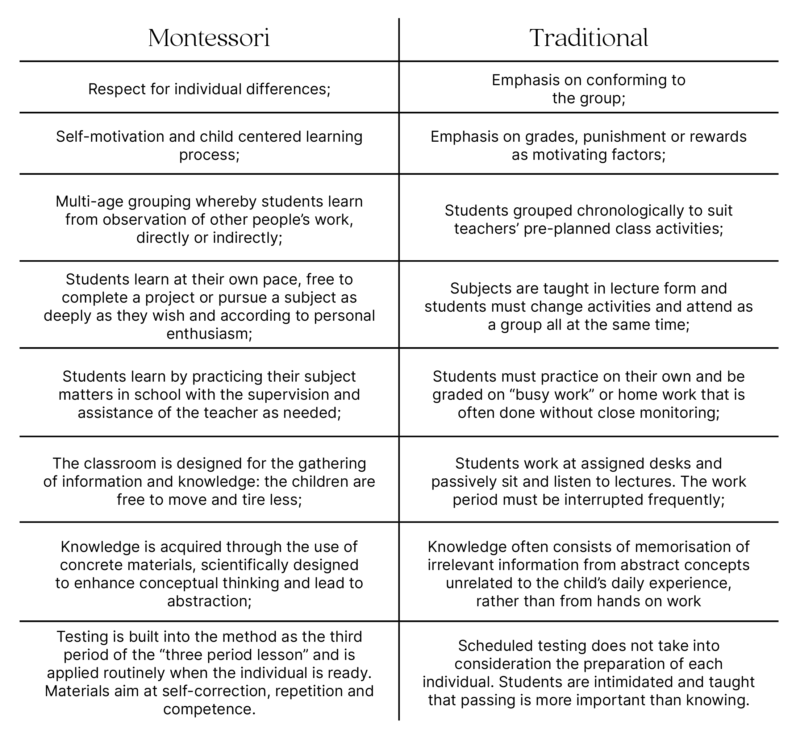
The Montessori pedagogy is founded on a scientific understanding of childhood and the development of the body and mind. Through her observations of children, Dr Montessori concluded that a child must be free to develop according to the natural laws of development, with no rewards or punishments, as well as no competition.
Dr Maria Montessori was a pioneering scientist and educator, and she based her approach on the development of the whole human being. Her work has been studied and developed for many years and is successfully evidenced today in neuroscience and research into the executive functioning skills of children and adults.
Through scientific research, Montessori based her educational philosophy on the idea that children develop through a series of four planes, from birth to maturity. Each plane has a variety of characteristics that are typical for children at that stage. Studying and understanding these stages enables us to understand our interactions with children with a new perspective.

The Montessori method, therefore, focuses on guiding each child, through positive experiences in a prepared environment, to independence in all spheres of development: physical, intellectual, social/emotional, and moral. And so, in a Montessori environment that meets the natural developmental needs of children, each child achieves self-mastery and self-discipline.
Born in Italy in 1870, Maria Montessori was one of the first women to attend medical school in Italy, and she qualified as a doctor from the University of Rome at the age of 26.
Soon after, Dr Montessori began practising medicine and, through her work with children, she developed an avid interest in education.
She opened her first education institution for children, Casa dei Bambini, in 1907 and published two seminal books – The Montessori Method (1909) and The Advanced Montessori Method (1917) – before establishing the Association Montessori Internationale (AMI) in 1929.
Her aim: “Spreading of knowledge of how the children, immature and struggling to develop their own powers, may be assisted in the self-realisation of reaching their full perfection of growth.” And today, there are over 22,000 Montessori schools in the world that are determined to pursue her work, with around 300 just in Australia.
For her committed efforts on behalf of children, especially in the face of fascism during World War II, Dr Montessori was nominated three times for a Nobel Peace Prize (1949, 1950 and 1951).

It is not true that I invented what is called the Montessori Method… I have studied the child; I have taken what the child has given me and expressed it, and that is what is called the Montessori Method.”
Montessori education is a natural process defined by positive experiences in a prepared environment where:
Research consistently shows that brain development and learning — ultimately, academic success — are optimised in an environment where children are free to choose work that:
As such, our lessons are given after careful observation of each child’s interests and ability level and are finely tuned to meet their need for meaningful and interesting effort.
Over four decades, Dr Montessori designed and constructed new materials, which is the name she used to describe the educational objects used in the classrooms, with each being particular to different subject areas (e.g., art, music, mathematics, language, science, etc). Montessori materials (also called jobs or work) offer students a great advantage: they are self-correcting, meaning that if a child makes a mistake, it will be evident to the child and they will then be able to try again – hereby reinforcing the importance of repetition.
In Montessori education, learning to write begins with the hands. Children develop the coordination, control and muscle memory needed for writing through carefully sequenced, hands-on materials and activities.
Cursive handwriting fits naturally within this approach. Rather than learning letters as isolated shapes, children experience their formation through movement. Materials such as the cursive sandpaper letters allow children to see, feel and trace each letter, connecting the sound of the letter with its shape and movement. The movable alphabet then gives children the opportunity to build words and express their ideas before they are fully able to write them independently.
This progression supports the Montessori principle of moving from the concrete to the abstract. Children first experience the sounds and movements of language through their senses and hands, before gradually developing the control and fluency needed for independent writing.
Research in neuroscience and psychology indicates that handwriting engages multiple areas of the brain, including those associated with cognition, language, memory and fine motor control. The physical act of forming letters helps integrate visual, sensory and motor processes, supporting the development of functional specialisation in the brain.
For Montessori students, handwriting is therefore more than a way of recording information. It is part of the child’s development of coordination, concentration, independence and self-expression.
| Pre-Primary | Children are introduced to cursive script through cursive sandpaper letters and the movable alphabet. They learn the sounds and formation of letters and begin combining these to build words and explore written language. |
| Lower Primary | Students continue to develop control, fluency and legibility. They learn how to organise and present their written work and are introduced to different styles and purposes of writing. |
| Upper Primary | Children increasingly develop their own individual handwriting style. As their control and confidence grow, they may also explore more decorative forms of handwriting, including calligraphy. |
| Lower Secondary | By this stage, students have developed a personal style of handwriting and the fluency to use it comfortably. Many continue to choose cursive handwriting as their preferred way of writing. |
Children are human beings to whom respect is due, superior to us by reason of their innocence and of the greater possibilities of their future… Let us treat them with all the kindness which we would wish to help to develop in them.”
– Dr Maria Montessori
Read about our school in Kingsley for children from the age of 3 to 18